quarta-feira, 29 de janeiro de 2014

AS CRUZADAS - HISTÓRICO DO MOTIVO DAS BATALHAS


Para iniciar, alguns dos princípios essenciais do islão:
O alcorão é a ultima revelação que Deus mandou para a humanidade, é a palavra de Deus e por isso imutável.
O muçulmano deve lutar até que o grande Califado mundial esteja estabelecido. Até lá o mundo é dividido em duas partes:
Dar-al-Salam a zona de paz, onde o islão domina.
Dar-al-Harb a zona de guerra, terra dos infiéis, que é para serem conquistados e subjugados como escravos.
A luta para conquista do Dar-al-Harb é o jihad e numerosas Suras do Alcorão prescrevem esse jihad para os muçulmanos.
Como exemplo algumas dessas suras:
Sura 2 Al-Baqarah
Sura 4 An-Nissa
Sura 8 Al-Anfal
Sura 47 Muhammad
A “obra” que Maomé começou com a conquista da península Arábica. É bom frisar que islamismo foi fundado na Arábia Saudita que nunca fez parte do Império Romano, foi completado apos a morte do profeta.
A seguir um cronograma das campanhas de guerra islâmicas na conquista do mundo Europeu.


632
Morte de Maomé

635
Um exército muçulmano conquistou Damasco, a capital do reino bizantino-cristã da Síria.
A cidade e o país estão a serem roubados e queimados, mortos ou escravizados os habitantes. Começa imediatamente a islamização forçada.
Isto significa que os não muçulmanos (kuffar) tem que pagar um imposto (jizya) e são praticamente privados de todos os direitos e proteção. Somente aqueles que colaboraram (convertidos) serão poupados.

636
Batalha de Kadesia. Conquista da Mesopotâmia, incluindo a capital sassânida de Ctesifonte. Imediatamente após a violenta vitória começam pilhagens generalizadas.
Depois a vitória Califa Umar ordenava a queimadura da Grande Biblioteca de Madain (comparável à Biblioteca Alexandria) como uma medida da islamização forçada. Mais tarde, motivado pelo fanatismo, os muçulmanos procuraram destruir todos os escritos antigos, onde que seja que eles os encontraram.

637
Um exército muçulmano conquistou Jerusalém, que fez parte do Império Bizantino Cristão.
Começa imediatamente a islamização forçada. Igrejas e sinagogas são saqueadas ou destruídas, matado a população masculina, as mulheres e crianças estupradas, e ou escravizados.
Uma parte dos sacerdotes são crucificados.

640
Conquista, pilhagem e incendiamento de Cairo. Quase toda a população masculina é massacrada, mulheres e crianças estupradas e escravizadas. A antiga biblioteca de Cairo em chamas. A forçada islamização começa imediatamente.

642
Batalha decisiva perto Hamadan (Ekbetana) contra o Império Sassânida. Grande parte do Irã de hoje cair nas mãos dos conquistadores muçulmanos. A belíssima Ekbetana, cidade presumivelmente mais antiga do mundo, é quase completamente destruída. Arte insubstituível e tesouros culturais perdidos. Começam imediatamente ações criminais extensas, pilhagem, escravização e islamização forçada que não for concluída até por volta do ano 900.

642
Um exército muçulmano conquistado e destruído o cristão bizantino Alexandria, capital do Egito cristão. A cidade e o país estão sob a fúria dos conquistadores. Já nos primeiros meses algumas centenas de milhares de cristãos foram assassinados, milhões de pessoas escravizados. Em uma tempestade de fogo sem precedentes os conquistadores destruírem não só os testemunhos cristãos mais antigos, mas também tudo o que a antiga Roma e Egito criaram. A Biblioteca de Alexandria, joia do mundo antigo (restaurado após o incêndio acidental durante a expansão romana) foi destruída de forma sistemática e intencionalmente. Mais de 4000 anos de história escrita, ciência cedo e poesia em chamas.

645
Um exército muçulmano conquistou o Barka cristã no Norte da África (Líbia). Destruindo a antiga cidade greco-romana completamente. Todos os habitantes abduzidos à escravidão.

650
As últimas áreas do Reino da Armênia são invadidas, saqueadas e com força islamizada.

652
Um ataque de piratas muçulmanos (Corsários), na ilha da Sicília é repelido. Mas as aldeias costeiras estão em ruínas. Muitos cidadãos morreram ou foram escravizados.

667
Novos ataques piratas muçulmanos (Corsários) na ilha da Sicília estão na agenda, mas são repelidos. Mais e mais aldeias costeiras e igrejas sendo fortificadas. No entanto, muitas vezes os moradores serão abduzidos novamente.

674
Um ataque de muçulmanos em Constantinopla (capital do Império Bizantino Cristão e sede do imperador cristão) é repelido. Na retirada o exército islâmico são arrasa as terras a leste do Bósforo, arrasta os habitantes à escravidão.

700
A ilha italiana de Pantelleria é conquistada pelos muçulmanos e os habitantes escravizados. A ilha está se tornando em um ninho de piratas muçulmanos.


708
Sicília é conquistada em curto prazo pelos muçulmanos, mas a reconquistada será com pesadas perdas e devastação.

708
A campanha muçulmana para a conquista da África do norte Cristão chega à costa atlântica.
Em seu avanço todas as cidades e aldeias do norte da África foram saqueadas e queimadas. Mais de 50% dos habitantes do Norte de África estão mortos no final da campanha. Milhões são estupradas, torturadas e escravizadas.

710
Com a conquista da última cidade cristã no Norte da África, todo o norte ex-cristão da África é islamizada. Quase todas as 400 dioceses cristãs no Norte da África perecem.  África do Norte era um mundo cristão floresce, terra de teólogos importantes da antiguidade cristã.

711
Exércitos muçulmanos atravessam o Estreito de Gibraltar e invadem a Europa. O início da conquista da Península Ibérica (hoje Espanha e Portugal). Começa imediatamente a islamização forçada dos territórios conquistados. Os impostos per capita são mais elevados e os castigos corporais mais duros do que em qualquer outro lugar sob as botas de ferro do Islã.

712
Conquistadores islâmicos alcançam as fronteiras da China e da Índia. Atrás deles (como cronistas contemporâneos relatam) são territórios conquistados em chamas. Logo os árabes conduzem as primeiras incursões também para Sindh. Fluxos altos de escravos alcançam os mercados do Oriente Médio.

712
A conquista muçulmana e islamização forçada do sul da Espanha estão quase completas.
Os mercados de escravos do Norte da África transbordam de escravos Europeus.

713
Os muçulmanos conquistam e saqueiam Barcelona, cruzam os Pirineus e invadem saqueando e tocando fogo em toda parte na área do atual sul da França. Cerca de 90 anos após a morte de Maomé, e cerca de 380 anos antes do início das Cruzadas cristãs, exércitos muçulmanos (é não "apenas" missionários muçulmanos!) estão terrorizando o reino cristão dos francos (atual França).

717
Outro ataque muçulmano em Constantinopla (capital do Império Bizantino Cristão e sede do Imperador Cristão) é repelido. Na retirada do exército, as terras a leste do Bósforo são devastadas, queimadas e o povo abduzido para a escravidão.

720
Os muçulmanos invadem o sul da França, conquistando Narbonne e sitiando Toulouse. A campanha de islamização forçada é menor do que o roubo e a aquisição de escravos.

720
Nova tentativa de desembarcar tropas muçulmanas na Sicília, onde ocorrem extensa combates e devastação.

731
Saqueando exércitos islâmicos rompem a fronteira no sul da França. De de Dijon até Sens, perto do Loire, e Langres até Luxeuil, toda a França ao sul do Loire realmente cai nas mãos deles.

732
O saque da rica cidade mosteiro de Tours falha por causa da derrota na Batalha de Tours e Poitiers. No entanto, os invasores muçulmanos saqueiam e devastam a paisagem na retirada. Ainda conseguem abduzir milhares de prisioneiros como escravos.

735
Muçulmanos atacam novamente no sul da França, com exércitos fortes. Embora eles não consigam a conquistar as cidades e países escolhidos, mas todos os moradores, que caiam em suas mãos, são escravizados, além disso mulheres e crianças estupradas.

751
Na Batalha de Talas, um exército árabe muçulmano derrotado pela primeira vez um exército chinês.


810
Tropas islâmicas ocupam Córsega e usá-lo a partir de agora como base para ataques à costa sul da França

831
Tropas muçulmanas conquistam e saqueiam a cidade siciliana de Palermo

832
Unidades muçulmanas assaltam e pilham Marselha, onde grandes quantidades de escravos e mercadorias são apreendidas.

835
De Sicília os muçulmanos passam para o continente e devastam Calábria.

838
Tropas islâmicas invadiram o sul da França e o vale o Ródano novamente para saquear.

840 até 847
Benevento, que está sob proteção franca, é ocupado pelos invasores islâmicos.

841
Depois de um curto cerco Capua é completamente destruída e saqueada.

841
Brindisi cai nas mãos dos invasores muçulmanos após pesados combates.

843
Tropas muçulmanas conquistam, saqueiam e incendiam a cidade siciliana de Messina.

843
Tentativas de conquista árabe de Roma falharam.
A cidade e a região são saqueadas e incendiadas, os sobreviventes da população escravizados.

846
Outras tentativas de conquista árabe da Roma falham.
A cidade e a região são saqueadas e incendiados, quem eles conseguem capturar são escravizados.

848
Em agosto de 848, a cidade de Ragusa, na Sicília foi saqueada e destruída pelos árabes, apesar do fato de que os moradores tinham feito paz com os árabes, e os deixou a cidade (de acordo com Ibn al-Athir).

848
Unidades muçulmanas assaltam e pilham Marselha, a região está devastada. Reféns e escravos são levados.

849
Tentativas de conquista árabe de Roma falharam.
A cidade e a região são saqueadas e incendiadas, os sobreviventes da população escravizados.

851 até 852
O Benvento e isento por um tempo curto é novamente ocupada pelos muçulmanos.
Os ocupantes cometem um massacre na população.

856
Invasores árabes atacam e destroem a Catedral de Canossa, na Apúlia. A cidade saqueada e escravos levados.

859
Tropas muçulmanas invadem e saqueiam novamente no sul da França.

868
Finalmente os árabes conquistam a cidade de Ragusa na Sicílial.

870
Os árabes conquistam a ilha de Malta e destroem a cultura cristã ininterrupta existente há quase 700 anos.

878
Tropas muçulmanas conquistam, saqueiam e incendiam a cidade siciliana de Siracusa.

880
Tropas muçulmanas conquistam e saqueiam Nice.

882
Invasores muçulmanos constroem na foz do Garigliano entre Nápoles e Roma, uma base a partir da qual eles atacam em Campania e também Sabinia em Lazio.

888
Tropas muçulmanas constroem em Provence em Fraxinetum uma nova cabeça-de-ponte, que submeteu-se aos mouros espanhóis. De lá, eles fazem saques no oeste de Arles (capital do reino de Borgonha) e ao longo do Rhone para Avignon, Vienne (perto de Lyon) e Grenoble.


902
Tropas muçulmanas conquistam, saqueiam e incendiam a cidade siciliana de Taormina.

911
O bispo de Narbonne não é capaz de viajar de França para Roma, porque os muçulmanos ocuparam as passagens de montanha. Assaltos, escravidão e saques são galopantes.

918
Tropas muçulmanas conquistam e pilham da Sicília o Reggio Calabria situado no continente adjacente.

920
Muçulmanos da Espanha cruzam os Pirinéus, livremente devastando a Gasconha e ameaçando Toulouse.

934
Gênova e La Spezia são atacadas, saqueadas e incendiadas por muçulmanos.

935
Gênova e La Spezia são novamente atacadas, saqueada e incendiada por muçulmanos.

939
Hordas muçulmanas avançam no norte via Genebra até as passagens de montanha nos Alpes suíços. A cidade é saqueada e escravos levados.

942
Tropas muçulmanas marcham escaldando e assassinando, cruzam o sudeste da França até o norte da Itália.

942
Nice é atacada, roubado e queimado pelos muçulmanos.

952 até 960
A partir das passagens de montanha Alpine tropas muçulmanas conquistam durante quase oito anos a Suíça.
Eles saqueiam e destroem nos anos seguintes, o Valais, Graubünden e partes do leste da Suíça. Entre 952 e 960 depois a Batalha de Orbe os árabes continuaram a dominar grande parte do sul e do oeste da Suíça, incluindo a Grande São Bernardo e avançaram no nordeste até St. Gallen, no sudeste até Pontresina.

942 até 965
Tropas muçulmanas conquistam o ducado de Sabóia

906 até 972
Tropas muçulmanas conquistam a Provence

964
Da Sicília tropas muçulmanas conquistam e pilham Rometta, situada no continente.

979 até 988
Sebük TEGIN declara a guerra sagrada (Jihad) contra os Hindu-Shah, cujo rei Djaypal (965-1001) 979 e 988 ele derrotou. Todas as fortificações dentro do Afeganistão para a fronteira com a Índia caem nas mãos de seus guerreiros muçulmanos.


1002
Bari é novamente conquistada e destruída pelos árabes.

1002
Genova é conquistada e saqueada pelos árabes.

1004
Pisa foi conquistada e saqueada pelos árabes

1009
Califa Al-Hakim ordenou a destruição sistemática de todos os santuários cristãos em Jerusalém. Além disso, a igreja do Santo Sepulcro (incluindo o Santo Sepulcro) é destruída.

1070
Os turcos seljúcidas, um povo nômade da Ásia Central, havia se convertido ao Islã no10 Século dC, ganha o controle de Jerusalém. A peregrinação pacífica para os locais sagrados de cristãos está mais e mais impedida. Ataques contra peregrinos para assassinato e escravidão é a regra.

1071
Batalha de Manzikert um exército bizantino cristão é destruído por um exército muçulmano. O muçulmano seljúcidas turcos conquistaram o coração do cristão Império Bizantino: Ásia Menor.

1099
Depois de aproximados 470 anos de agressão militar e expansão do Islã, começam, como uma reação contra essas agressões islâmicas, as Cruzadas dos Cristãos.
Ideias imperialistas aparecem somente no século 18~19 na Europa.

O foco das Cruzadas era meramente até por necessidade, na maioria e seu começo, religioso e defensivo.


UM POUCO DA EUROPA HOJE


Ultimamente, tenho visto várias chamadas de artigos sobre a questão da invasão cultural islâmica na Europa.

Como sou neófito nesse assunto, eu perguntei a um amigo, natural da Alemanha [ele está +- 3 meses no Brasil] sobre a questão dos islâmicos.

Ele falou-me que existem muitos muçulmanos na Alemanha, principalmente pessoas provenientes da Turquia. No geral, os turcos vão para a Alemanha em busca de melhores oportunidades de trabalho [melhor qualidade de vida].

Na opinião do meu amigo, o problema não são os imigrantes em busca de trabalho. O problema é a naturalização desses primeiros imigrantes. Ao obter a cidadania alemã, o imigrante está autorizado a trazer vários familiares para a Alemanha.

Creio, que os familiares do imigrante naturalizado, tenham os mesmos direitos positivos dos nativos. Assim, obviamente, esses familiares podem obter direitos positivos [auxílio moradia,...] sem ter contribuído anteriormente. Além disso, essa política encoraja a imigração de pessoas descompromissadas com o trabalho e vida social.


Rei da Polônia Jan III Sobieski

Na questão da religião, conforme meu amigo, o problema não são os costumes da religião Islâmica, mas sim o simples fato deles serem religiosos. Para ser mais claro, muitos alemães são ateus [principalmente jovens]. E eles são extremamente desconfiados de pessoas religiosas [independente da religião].


Em relação a criminalidade, muito raramente, acontecem crimes por motivos culturais do Islamismo [por exemplo, o namorado matar a namorada por algum motivo da religião].


Por fim, ele falou-me de algo muito curioso, o kebab de carne de porco. Prato muito fácil de ser encontrado na Alemanha [obviamente, prato adaptado para os alemães].

o que na verdade existe é muito papo furado.

O islamismo se considera religião e foi construída/fundada como doutrina política militar por um guerreiro na Arabia Saudita que nunca fez parte do Império Romano.

Em menos de 150 anos de existência já tinha tomado o norte da África e feito parte da Europa escrava.

Por 1200 anos foram donos do mundo - o maior e mais duradouro império já existente.

Em suas escrituras boa parte da Europa é considerado território islâmico e quem vive nessas terras são escravos e devem pagar tributos.
Como isso não esta ocorrendo então é justo o FITNA.
Isso quer dizer que qualquer pessoa é alvo legítimo de guerra e terrorismo - isso inclusive crianças.

Em Viena, em território Alemão, foi a ultima batalha de expulsão deles da Europa. Isso agora recente 1683.
A questão é que de fato sempre existiu a guerra do Oriente contra o Ocidente Livre e até hoje o Islã e seus escravos, os esquerdista, tentam contra a civilização.
Desde antes da Pérsia, até as duas grandes guerras, eles sempre estão tramando a invasão.

A Batalha de Viena (alemão: Schlacht am Kahlenberg, polonês: Bitwa pod Wiedniem ou Odsiecz Wiedeńska, turco: İkinci Viyana Kuşatması), ucraniano: Віденська відсіч (Viděns'ka Vidsič) aconteceu em 12 de setembro de 1683 depois de Viena estar sendo sitiada por tropas do Império Otomano por dois meses. 
A batalha impediu o avanço do Império Otomano na Europa, e marcou a hegemonia política da dinastia dos Habsburgos na Europa central.

A batalha em larga escala foi vencida pelas forças polaco-austro-alemãs lideradas pelo Rei da Polônia Jan III Sobieski contra o exército do Império Otomano comandado pelo Grão-vizir Merzifonlu Kara Mustafa Paşa.


A cultura do ocidente livre nasceu do encontro entre Jerusalém (5774 anos), Atenas e Roma. Do encontro na fé no Deus de Israel, a razão filosófica dos gregos e o pensamento jurídico de Roma.

Esse tríplice encontro formou a identidade intima da Europa, e hoje, do mundo livre.
Na consciência da responsabilidade do homem diante de Deus. A defesa desses valores é nossa tarefa: A fé cristã, o direito romano e a filosofia grega.

Esquerdistas em geral, possuem ódio à civilização ocidental judaico-cristã, por considerá-la preconceituosa e etc e tal. Mas é justamente essa civilização a única em que as mulheres são realmente respeitadas no mundo. De resto temos somente a barbárie.

De índios a árabes, de africanos a indianos. É só botar a cabeça pra pensar e observar onde tem civilização tem os valores judaicos/gregos/romanos/cristãos.


TEMPLÁRIOS ASSASSINOS?


Contar a história no ocidente é quase impossível acabei de ver essa imagem dos templários que diz: Credo de assassinos.

Um xiita ismaelita do século XI de nome Hassan Ibn Sabbah (mais conhecido como "o Velho da Montanha"), comandava na Síria um pequeno exército que utilizava para executar cruéis vinganças políticas e submeter terror a região.

Para estimular ainda mais a crueldade de seus homens, obrigava-os a consumir haxixe antes de sair a campo, com o qual os seus guerreiros se tornavam ainda mais cruéis e sem piedade.

Por essa razão, os sequazes do "Velho da Montanha" eram chamados hashashin, que em árabe significa "consumidor de haxixe", mas a palavra em pouco tempo seria usada para designar também aos matadores.

O velho líder teve sucessores que continuaram com os mesmos sangrentos métodos de dominação, até que o último deles foi capturado e executado sumariamente por Gengis Khan.

A palavra "assassino" aparece usada pela primeira vez em português por volta do Século XII. Em séculos anteriores, registram-se as variantes: "anxixín", "acecino", "assasino" e "assesino". Este vocábulo, que foi trazido do Oriente pelos Cruzados, chegou também ao francês e inglês como "assassin", ao espanhol como "asesino", ao italiano como "assassino".

AGORA O ISLÃ EXPLICA!

Segundo Amin Maalouf, no seu livro Samarcanda:
"A verdade é outra. De acordo com os textos que nos chegam de Alamut, Hassan Sabbah gostava de chamar os seus adeptos de assassiyun, os que são fiéis ao Assass, ao «fundamento» da fé, e esta palavra, mal compreendida pelos viandantes estrangeiros, é que pareceu ter um ressaibo de haxixe" (…) Marco Polo popularizou essa ideia no ocidente. 

Deu-se crédito à tese de que eles atuavam sob o efeito do haxixe e os seus inimigos no mundo muçulmano chamavam-lhes por vezes haschichiyun, «fumadores de haxixe», para os desconsiderar. Alguns orientalistas julgaram ver neste termo a origem da palavra «assassino», que se tornou, em várias línguas europeias, sinônimo de homicida."

E QUEM FOI AMIN MAALOUF EM POUCAS LINHAS?

Ele escreveu As Cruzadas vistas pelos Árabes (no original em francês: "Les Croisades vues par les Arabes") é um livro do escritor franco-libanês Amin Maalouf, publicado originalmente em 1983 e traduzido para vários idiomas.

Como o próprio nome sugere, o livro narra as opiniões dos árabes sobre as Cruzadas e, sobretudo, sobre os cruzados - os "Franj" (Francos), como eles os chamavam -, tidos como cruéis, selvagens, ignorantes e culturalmente atrasados.

Combinando História e Literatura, Maalouf simula uma autobiografia (mas baseada na história real) de Hasan al-Wazzan, um embaixador árabe que, no ano de 1518, em viagem de peregrinação à Meca, foi capturado por piratas sicilianos e entregue ao grande papa da Renascença, Leão X.

Das primeiras invasões, no Século XI, até a derrocada geral das Cruzadas, no Século XIII, o livro constrói uma narrativa inversa àquela que é corrente no mundo ocidental, percorrendo uma longa galeria de figuras humanas famosas, descrevendo os principais fatos belicosos, e exibindo situações pitorescas de um cenário histórico onde os cristãos são vistos como "bárbaros", desconhecedores das regras mais elementares de honra, dignidade e ética social.


Vejam como são usadas as crianças na palestinas (aqui) e (aqui)

Osvaldo Aires Bade Comentários Bem Roubados na "Socialização" - Estou entre os 80 milhões  Me Adicione no Facebook 


1º - AS CRUZADAS (aqui)

2º - CRUZADAS (aqui)

3º - AS CRUZADAS - HISTÓRICO DO MOTIVO DAS BATALHAS (aqui)

4º - OBAMA ESCOLHE MUÇULMANO COMO DIRETOR DA CIA - ISLÃ NOS EUA (AQUI)

5º - GUERRA DOS SEIS DIAS (aqui)

6º - A VERGONHOSA ATITUDE DA FAMÍLIA MARINHO, O SBT, O ISLAMISMO, O COMUNISMO, O PETISMO E CUBA (AQUI)


Olavo de Carvalho O INFERNO


1º - SOLUÇÕES COMEÇAM COM A VERDADE! NÃO SE TRATA DE "OCUPAÇÃO" - SE TRATA DO ISLÃ... (AQUI) 

2º - ISLÃ PECADOR MORRENDO NA PAZ - MULHERES SÃO VISTAS COMO PROPRIEDADES DOS HOMENS NO LÍBANO PAÍS MAIS AVANÇADO DO MUNDO ÁRABE (AQUI) 

3º - Islã 101: Uma Introdução ao Islã e a Jihad Islâmica (AQUI) 

4º - O LÍBANO É PARA CRISTÃOS: O POVO FENÍCIO NÃO SÃO ÁRABES (aqui) 

5º - Terrorista do Isis prega no Brasil e a PF nada fez - O Islã avança no Brasil! (aqui) 

6º - VEJAM POR QUE TANTOS BRASILEIROS DEFENDEM A PALESTINA! ENTIDADE QUE FINANCIAVA O TERRORISMO DO HAMAS ERA DIRIGIDA POR BRASILEIRO, HOJE NA CADEIA (aqui)


7º - PARADOXOS DOS MUÇULMANOS: ONDE OS MUÇULMANOS SÃO FELIZES? ONDE OS MUÇULMANOS SÃO INFELIZES? (aqui)

8º - Brasil não reconhece mais Jerusalém como capital de Israel (aqui)

9º - 
ÍNTEGRA DO ESTATUTO DO HAMAS E DOCUMENTÁRIO DAS TENTATIVAS DE PAZ NO MUNDO ISLÂMICO 
(aqui)

10º - LAG BA’OMER (aqui)
.
11º - VEJA AQUI QUEM MUDOU O NOME DO PAÍS DE JUDEIA PARA SYRIA PALESTINA (AQUI)
.
12º - ISRAEL E O SEU VIZINHO MAIS CIVILIZADO: O LÍBANO. E POR QUE? (AQUI)
.
13º - OS JUDEUS NO ESPAÇO ALEMÃO E A PROCURA DE UMA PÁTRIA (aqui)
.
14º - AS CRUZADAS - HISTÓRICO DO MOTIVO DAS BATALHAS (aqui)


Radical muçulmana se finge de moderada para tentar encurralar -- logo quem! -- David Horowitz


Achando que conseguiria pegar no contrapé o genial David Horowitz numa palestra no campus de UC San Diego (um dos campus mais esquerdistas dos EUA), uma estudante radical é confrontada com sua própria incoerência e admite publicamente o que poucos admitem.

Brigitte Gabriel responde Muçulmana que se faz de vítima


Vídeo que apresenta Brigitte Gabriel, autora e ativista anti-Jihad, respondendo a pergunta de uma muçulmana que tenta se fazer de vítima, e minimizar o perigo do radicalismo islâmico para o mundo livre.


terça-feira, 28 de janeiro de 2014

INVESTIGADOR É DETIDO APÓS REAGIR A ASSALTO


Segunda-Feira, 27/01/2014, 19:54:01 - Atualizado em 27/01/2014, 22:58:43
Segundo informações da Polícia Civil, o investigador que foi encaminhado para a delegacia do Marco, no final da tarde desta segunda-feira (27), teria reagido após uma tentativa de assalto.
O caso aconteceu na avenida Almirante Barroso, esquina com a travessa Humaitá, bairro do Marco. De acordo com as informações da polícia, um homem tentou roubar o celular do investigador, que sacou a arma e efetuou os disparos. Segundo a delegacia que recebeu o caso, após a reação do policial houve uma discussão dele com um Guarda Municipal que testemunhou a ação. 
Após a discussão, o investigador saiu do local, mas acabou detido em frente ao colégio Souza Franco, próximo a travessa Timbó, portando uma pistola ponto 40.
O caso continuará sendo investigado na delegacia do Marco e o policial poderá responder por atentar contra a vida de outros cidadãos ao efetuar disparos em via pública.
OUTRO CASO
Um policial teve um ataque de fúria, no último dia 21, após não ser satisfatoriamente atendido pela Rede Celpa. O escrivão da Polícia Civil, identificado apenas como Léo, manteve vários funcionários como reféns em posto localizado no quilômetro 2 da rodovia BR-316, em Ananindeua. Ele também quebrou as vidraças do estabelecimento com um extintor de incêndio.
Na semana passada, no dia 21,   
(DOL com informações da Polícia Civil)
Leia mais:

Osvaldo Aires Bade Comentários Bem Roubados na "Socialização" - Estou entre os 80 milhões  Me Adicione no Facebook 

1º - OPERAÇÃO RESGATA DE BOATE NO CENTRO DE BELÉM CRIANÇA E ADOLESCENTES - QUADRILHA QUE ATUA NO RAMO DE BOITES (aqui)

2º - SARGENTO DO EXÉRCITO PRESO PROTESTANDO NA PONTE RIO NITERÓI (aqui)

CIENTISTAS TRAÇAM RETRATO DE HOMEM QUE VIVEU NA EUROPA HÁ 7 MIL ANOS

La Braña 1, nome usado para batizar indivíduo de 7 mil anos que viveu no período Mesolítico, que tinha olhos azuis e pele escura (Foto: PELOPANTON / CSIC)


Análise de DNA descobriu que indivíduo tinha pele escura e olhos azuis. 
Investigação sobre o caçador-coletor ibérico foi publicada na 'Nature'.

Da France Presse

Ele vivia na Espanha há cerca de 7.000 anos, tinha, provavelmente, a pele e os cabelos escuros e os olhos azuis: uma equipe espanhola mapeou pela primeira vez o genoma completo de um caçador-coletor europeu.
Este estudo, publicado neste domingo (26) pela revista científica "Nature", permite traçar o retrato de um europeu do período Mesolítico - entre o Paleolítico e o Neolítico - quando a subsistência ainda era garantida pela caça e pela coleta.
A pesquisa também fornece dados sobre as mudanças trazidas à fisiologia humana através da introdução progressiva na Europa, no período Neolítico, da agricultura e da domesticação.
A equipe de pesquisadores liderada por Carles Lalueza-Fox, do Instituto de Biologia Evolutiva de Barcelona, analisou o DNA de um dente de um dos dois esqueletos masculinos descobertos em 2006 na gruta de La Braña-Arintero, na província de León, noroeste da Espanha. As ossadas, preservadas em boas condições, são datadas de aproximadamente 7.000 anos, correspondendo ao período Mesolítico - 10.000 a 5.000 anos.
O estudo mostra que o caçador-coletor da península ibérica era geneticamente distante das populações europeias atuais, mas estava, contudo, mais próxima dos europeus do Norte de hoje, como suecos e finlandeses.
As comparações com outras amostras antigas parecem, ainda, indicar uma 'continuidade genética' através da Europa ocidental e central, desde o Paleolítico superior até o Mesolítico.
Mal capacitado para digerir leite e cereais
A pigmentação da pele do indivíduo de La Braña era provavelmente escura, e seus cabelos castanhos. Mas ele também era portador de uma mutação que, no homem contemporâneo, acarreta em olhos azuis. "Este fenótipo raro não existe nas populações europeias contemporâneas", ressaltou Lalueza-Fox.

"Até o momento, nós considerávamos que a cor da pele clara havia evoluído muito cedo na Europa, no Paleolítico superior, em função de uma baixa atividade de raios solares UV em altas latitudes", explicou. "Mas este certamente não foi o caso. Essa evolução ocorreu muito mais tarde, provavelmente no Neolítico", disse o pesquisador. Ela poderia estar associada às mudanças no regime alimentar e à diminuição da ingestão de vitamina D por parte dos criadores, em relação aos caçadores.
Os geneticistas também se debruçaram sobre os genes do sistema digestivo do caçador-coletor de La Braña para tentar retraçar a história de duas adaptações 'recentes' do regime alimentar do homem adulto: o consumo de leite e de amido, encontrado hoje nos cereais e na batata, por exemplo.
Ele mostraram que o indivíduo de La Braña era portador da variação genética ancestral que produzia uma intolerância à lactose. Da mesma forma, o homem não era geneticamente preparado para ter uma dieta rica em amido.
"Estes resultados sugerem que o caçador-coletor de La Braña tinha capacidades medíocres para digerir o leite e o amido, levando à hipótese de que estas faculdades foram adquiridas mais tarde, com a introdução da agricultura", afirmaram os pesquisadores.
Por outro lado, eles mostraram que diversas variações genéticas associadas à resistência aos agentes patogênicos nos europeus modernos já estavam presentes neste indivíduo. Não se trataria, então, de uma adaptação ligada à passagem ao modo de vida agrícola e à domesticação animal.
"A análise de outros antigos genomas da Europa central ou do norte será necessária para confirmar que as características genéticas do indivíduo de La Braña podem ser generalizadas a outras populações do Mesolítico", concluem os pesquisadores.

Osvaldo Aires Bade Comentários Bem Roubados na "Socialização" - Estou entre os 80 milhões  Me Adicione no Facebook 

KIEV BECOMES A BATTLE ZONE AS UKRAINE PROTESTS TURN FATAL


Fonte: (aqui)
Deaths of at least three demonstrators come as businesses near protest hub reportedly ordered to close
Wednesday is Ukraine's Day of National Unity, but the country has never felt so divided.At least three people have died in Kiev, the first casualties of a protest movement that has rumbled on for two months before bursting dramatically into violence over the weekend.

Two protesters were shot dead during clashes with police, who attempted to take back control of the city centre. Prosecutors confirmed earlier claims by the protest leaders that the pair had been shot with live ammunition. A third protester died after falling from a high column at Dynamo Kiev's football stadium while fighting with police, Reuters reported.

Oleg Musiy, the coordinator of the medical service at Independence Square, told a pro-opposition radio station that another two people had been killed, though this could not be confirmed.

As President Viktor Yanukovych held long talks with the trio of opposition leaders who have led the protests for the past two months, the deaths seemed likely to further inflame the tense situation in the country.

Parts of central Kiev resembled a battle zone as thick clouds of smoke filled the air and the sound of stun grenades rang out. Police shot at demonstrators with rubber bullets, and rumours swirled that a storm of the main protest encampment, the heavily barricaded Independence Square, could begin at any time. At one point, police deployed an armoured personnel carrier to back up their movements.


Martial law was effectively declared at 4pm local time, as shops, hotels and other businesses in the area surrounding the hub of the protests were reportedly ordered to close their doors for the day. A full-on storm was not immediately forthcoming, however.

Riot police pulled back from further clashes but were involved in a protracted standoff with protesters near the Dynamo Kiev football stadium overnight. People brought thousands of tyres to create a blazing wall in between the police lines and the protest barricades. At midnight, a full-scale firework display was launched, with the rockets aimed horizontally at police. On Independence Square, the already formidable barricades were augmented with more sacks of snow, metal railings and tyres.

The first attempts to push back protesters came as dawn broke, amid a swirling blizzard. Police began their assault on the impromptu barricades on Hrushevskogo Street, where clashes have been ongoing since Sunday evening. Videos circulated of the police beating and kicking protesters, many of whom were hurling rocks and molotov cocktails at officers in scenes that shocked residents of Kiev. Political protest has been a way of life here since the 2004 Orange Revolution, but before this week, rallies have never descended into violence.


Police launched another attack on protesters shortly after midday Kiev time (10am GMT), dispersing a crowd of thousands of people, moving them hundreds of metres back. They used teargas and rubber bullets and beat fleeing protesters with sticks. Some people were arrested. Then thousands of policemen regrouped into new lines to take shelter from stones being hurled at them.

Even as his riot police were on the attack, Yanukovych released a statement urging them to "regulate the conflict in a peaceful way" and saying he was against "bloodshed and forceful methods". He asked the opposition to hold talks and demanded that people "not heed the calls of political radicals".

Vitali Klitschko, the opposition leader and former heavyweight boxer, called on Yanukovych to announce snap elections as a way to resolve an ongoing political crisis.
"I know that this very second he [the president] is watching this live broadcast. You, the president, you know that snap elections will change the situation without blood, and we'll do everything to achieve this," Klitschko told the crowd in Independence Square on Wednesday evening. He added that talks with Yanukovych that started on Wednesday would have to continue on Thursday, otherwise "we will go on the attack".
Yanukovych on Wednesday met the three main opposition leaders – Klitschko, nationalist Oleh Tyahnybok, and Arseniy Yatsenyuk, of jailed former prime minister Yulia Tymoshenko's party – for three hours.

The prime minister, Mykola Azarov, struck a defiant note, blaming the victims for their own deaths and saying that the government had "no other option" but to use force against protesters.

"The participants of these disturbances cannot be called peaceful. These are criminals, who are disturbing order. I want to officially state that the victims are the responsibility of the troublemakers."

Azarov said terrorists were threatening the lives of ordinary citizens in Kiev, and that the "criminal" actions of protesters would be punished and suggested further force was possible. He was due to appear at the World Economic Forum in Davos later on Wednesday, but his invitation was reportedly withdrawn.


Earlier the protesters reconstructed their barricades as thousands came to support them.
In a letter read out by her daughter Eugenia in Independence Square, Yulia Tymoshenko called on the protesters to continue their struggle. "The blood of these heroes of Ukraine lies on the hands of Yanukovych," the letter said. "If we, Ukrainians, forgive him this, then we will deserve everything he will do to us later."

Vasyl, 76, a pensioner from the central Cherkasy region, said: "They [the authorities] provoked this. We are unarmed but nevertheless they are afraid of us." His friend Pavlo, 60, wearing stripes in the colours of Ukrainian and EU flags, said he came to support the protesters and was ready to throw stones at police.

"The blood is the fault of the convict [Yanukovych] and his party. We want these occupiers to leave Ukraine."

An exhausted Orthodox priest with a huge cross around his neck trudged between the lines, trying unsuccessful to bring calm. "I'm here to placate the violence. My congregation is here," he said.

Yuriy Lutsenko, a Ukrainian former interior affairs minister, called on riot police to stop fighting against the protesters. "Soldiers, if you stand here we will become Russia and you will have to go and fight in Chechnya," he said through a loudspeaker, addressing lines of police from a minivan in the middle of the crowd. "This is not your war. This is a war of the Ukrainian people against the mafia."


The protests began when Yanukovych turned his back on a planned association agreement with the European Union, citing financial pressure and the need for closer ties with Russia. They have since grown into a more general protest against Yanukovych's government, and have also attracted a noisy minority who hold radical far-right views.

Condemnation of the violence came in a torrent from across Europe. Carl Bildt, the Swedish foreign minister, described the situation as extremely serious. The EU's response remains to be seen, he said, but "it won't be business as usual". José Manuel Barroso, president of the European commission, said he was shocked at the deaths. He added: "I would like to explicitly underline the fundamental responsibility of the Ukrainian authorities to now take action to de-escalate this crisis and, in particular, the need for them to engage in a genuine dialogue with the opposition and with civil society on the ways to overcome this deep crisis."

The United States revoked visas to several Ukrainian officials on Wednesday over the violence in November and December of last year.


The main voice of support for tough action has come from Moscow, where on Tuesday, foreign minister Sergei Lavrov accused European politicians of "fuelling" the violence in Ukraine, and noted that in any European country, the seizure of public buildings and violence against police would also be met with force.

Osvaldo Aires Bade Comentários Bem Roubados na "Socialização" - Estou entre os 80 milhões  Me Adicione no Facebook 


UKRAINE'S VITALI KLITSCHKO: 'THIS IS A BATTLE AND I DON'T PLAN TO GIVE UP EASILY'

Fonte: (aqui)

As Ukraine's street protests against corruption grow increasingly ugly, the unlikely figure of heavyweight boxer Vitali Klitschko has emerged as a voice for the opposition. What will happen next – and why has he taken on the biggest fight of his life?


Klitschko in Kiev … 'We need to join all our forces.' Photograph: AP

People have been trying to land kicks and punches on Vitali Klitschko for most of the past two decades, and he has brushed almost all of them off with ease. But his current opponent, Ukrainian president Viktor Yanukovych, has a few advantages that none of the previous challengers possessed: several thousand riot police at his disposal, for a start, and the use of a pliant court system to prevent Klitschko from entering the ring in the first place.


Klitschko, whose PhD in sports science combined with a fearsome reputation as a former heavyweight champion earned the 42-year-old the nickname "Dr Ironfist", has emerged as the natural leader of the street protests that have swept Ukraine for the past two months, ever since the president went back on his promise to sign an association agreement with the EU. Crowds, mainly from the pro-European west of the country, were initially drawn to stand up for their desires of European integration, but the rallies soon morphed into general discontent with the bloated kleptocracy that critics say surrounds the president. Barricades were erected around Independence Square, and every day for two months, politicians including Klitschko have addressed crowds from the stage, rallying the masses in protest against the president he eventually hopes to succeed. 


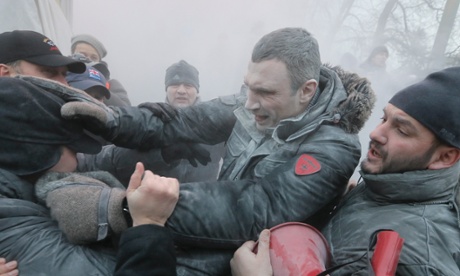
Klitschko has his hands full trying to contain the protest movement which erupted into violence on Sunday night, as thousands hurled rocks at riot police and set their buses on fire. Klitschko was moving through the crowds, unsuccessfully calling for calm, and at one point was even sprayed in the face with a fire extinguisher by an angry protester.
But despite the difficulty and complexity of the task ahead, Klitschko is resolutely confident that the protests, which have so far failed to draw any major concessions from Yanukovych, represent a victory for the Ukrainian people.

"People are saying: 'We don't want to live like this. We want things to change,' he tells me just days before the mood turned violent. "This is a victory in the head of every Ukrainian, and in their heart – and this is worth an awful lot."

Dressed in a dark grey suit that sits surprisingly elegantly on his enormous frame, Klitschko speaks slowly and methodically.

"The system today is built to service the clan, the family, and not society as a whole. Yanukovych doesn't want change. He says he does. But he says he wanted European integration and that turned out to be a con."

He pauses, blinking, before answering each question, usually with carefully formulated and somewhat monotonous answers. Would he put Yanukovych on trial for the corruption that has escalated under the current regime, and the blatant enrichment of his family members? Klitschko pauses. 

"If people break the law, they should be punished," he says. So is that a yes? What does he personally think about Yanukovych? He pauses again. "If people break the law, they should be punished." It is as though he has discovered the concept of speaking like a politician, but not yet mastered the craft.

He might lack the fiery charisma of born political leaders, but in a country where the 2004 Orange Revolution was followed by huge disappointment, and people are all too used to broken promises from politicians, Klitschko's plodding sincerity and political neophytism are attractive qualities. Unlike many Ukrainian politicians, he is free from allegations of corruption. The expensive watch on his wrist and the smart cars he drives can be accounted for by the millions that he earned in transparent fashion in the boxing ring.

Klitschko's boxing statistics are extraordinary. He won 45 of 47 professional fights, and was never knocked out once. Boxing aficionados suggest that the time of his dominance was not a particularly glorious era for the sport and that he never faced a truly brilliant challenger, making him a boxing equivalent of Pete Sampras – repeatedly victorious yet not destined to be remembered as one of the all-time greats. Nevertheless, along with his younger brother, Vladimir, he has completely dominated the sport for a decade.

Klitschko's father was a Soviet military pilot, and the young Vitali grew up on military bases across the former Soviet Union, moving from the Central Asian steppes to the Baltic before settling in Kiev in 1984 as a teenager. With its chiselled features and sombre expression, Klitschko's face could come from a Stalin-era poster extolling the Soviet sporting hero,and his aura of moral grounding and sincerity certainly came across during his boxing career. He cut an unusually polite figure in a milieu normally associated with hubris and puerile bravado. 

Klitschko recalls a fight against Briton Richard Vince, in Norwich, back in 1994. It was before he had become boxing world champion and was instead tearing up the kickboxing circuit, and he travelled to Britain for a world title fight in the sport.

"The whole family of my opponent came to the fight and were sitting in the front row. His dad, mum, wife and kids were there. I knocked him out in the second round and he blacked out. He was lying there unconscious, and I saw pain in the eyes of his family. After that I said that my relatives should never come to my fights. I don't want to cause those emotions in my family." He also says he sought out Vince's relatives and apologised to them after the fight. When his brother Vladimir, five years his junior, also became a successful heavyweight boxer, he promised his mother that the pair would never fight each other.


Klitschko, center, is attacked and sprayed with a fire extinguisher as he tries to stop clashes. Photograph: Efrem Lukatsky/AP
I try my hardest to steer clear of hackneyed comparisons between the boxing ring and the Ukrainian political fight, but Klitschko himself repeatedly wheels out the metaphors. Even the name of his political party, the Ukrainian Democratic Alliance for Reform, handily condenses into the acronym Udar, the Russian and Ukrainian word for "punch".

When I ask whether he feels uneasy sharing a stage with Oleh Tyahnybok, the hardcore Ukrainian nationalist known for his antisemitic outbursts, he raises a supersized hand in front of him and curls it into a fist.

"In order to land a punch, you need to bring your fingers together into a fist. We need to join all of our forces together. That is the only way that we can win."

Klitschko and Tyahnybok have been joined on the stage by Arseniy Yatsenyuk, the representative of jailed former prime minister Yulia Tymoshenko's Fatherland party.
"Three things unite us," says Klitschko of the troika of opposition leaders. "The first is disagreement with the current economic situation; the second is that we see European integration as the only future for Ukraine, and the third is the struggle against the current authoritarian regime."


Tymoshenko, who was one of the leaders of the Orange Revolution, was considered Yanukovych's most dangerous potential enemy before the emergence of Klitschko, and most people believe her jailing was a political decision. However, Yatsenyuk lacks the charisma of his party leader, and with his spectacles and roll-neck jumpers looks more like a linguistics professor than a rousing political leader.

With Tyahnybok's appeal limited to the more nationalist west of Ukraine, most people assume that if the opposition puts forward a united candidate to take on Yanukovych in presidential elections, Klitschko is the only viable choice to appeal to a broad demographic. The vote is scheduled for 2015, though one of the key demands of the protests from the start has been early elections.

The government has attempted to bar him from any future presidential race by introducing a new law that would disqualify him due to his extended absences from the country while he pursued his boxing career. He was resident in Germany for a long period, and recent rumours in the Ukrainian press say he also has a US social security number and pays US taxes. The boxer, who suddenly starts referring to himself in the third person, says the new electoral law is a nonsense.

"The idea is deliberately being fed to society that Klitschko can't stand. I have always been a citizen of Ukraine since the moment of our independence. I was registered in Ukraine and I live in Ukraine. But sport is global, and everyone knows that you can't limit yourself to one country. The authorities are doing everything to ensure Klitschko can't stand in elections. But I will say it once again: there are no reasons to remove me from the elections."

When I ask what he will do if he, nevertheless, is banned from standing, he is evasive, saying he will "defend his position firmly". What does this mean? "My position is clear to everyone … and I am certain that they won't do something so stupid. It would be the same as saying that ice is warm or water is dry." Yanukovych's government has made its fair share of decisions that many might regard as stupid over recent months, I point out.


Klitschko, right, lands a punch on Britain's Dereck Chisora during a title bout in 2012. Photograph: Frank Augstein/AP

"Then I will fight it. This is a battle, and I don't plan to give up easily."
The question of just how far he is willing to go in terms of violent opposition to a regime that has refused to listen to peaceful protest remains unanswered, but he is insistent that any violence is the fault of the authorities.

"The protest mood in Ukraine is at a higher temperature than ever before," says Klitschko towards the end of the interview. "We only need a small spark for the situation to develop in a way that will be completely out of control for the authorities."
His words turn out to be prophetic, as the rally on Sunday turned violent, with dozens of protesters and police injured, and the way out of the political impasse is now even more unclear. Klitschko will need to negotiate the landscape and make a decision on whether he goes for all-out war with the regime, or bides his time until a 2015 vote. He went to see Yanukovych on Sunday evening, where the president offered to start negotiations with the opposition leaders. However, on Monday, it was announced that Yanukovych himself would not attend the talks.

"Not signing the EU integration agreement, attacking peaceful protesters and ignoring human rights – all of these were indicators of the way things are in Ukraine right now. If these things keep happening, then nobody can predict how it will end."

Klitschko warned Yanukovych on Sunday night to "find strength and not repeat the fate of Ceausescu and Gaddafi", referring to the former Romanian and Libyan dictators who ended up dead. He added that if the government did not pull back from violence then "civil war cannot be ruled out". While the majority of protesters remain peaceful, it is clear that the radical element is growing, partly in reaction to new anti-protest laws which essentially make the street rallies that have paralysed the capital illegal.

Klitschko announced recently that he was retiring from boxing to concentrate on his political career. He has been given "champion emeritus" status, which would allow him to mount a challenge to any new champion at any time, but he says that such thoughts are far from his mind at the moment.

"I am thankful for this title of champion emeritus, and proud I never lost my title. A lot of people want to see a last fight, but I am now engaged in a different fight. One that is much harder, much more vicious and much more important to me. I am fighting for democracy, and fighting for Ukraine."

Kiev protests intensify on Ukraine's Day of National Unity - video


Clashes between anti-government protesters and police have intensified on Wednesday following the death of two protesters overnight. Wednesday is Ukraine's Day of National Unity, although the socio-political climate is anything but united. Martial law has effectively been declared, with parts of the capital resembling a battle zone. Protests began two months ago when President Yanukovych snubbed an agreement with the European Union in favour of closer ties with Russia


Ukraine's opposition leaders address protesters after rejecting Yanukovych's compromise - video


Leaders of Ukraine's main opposition party address a crowd of anti-government protesters on Saturday in Kiev's independence square, also known as Maidan Nezalezhnosti. The main opposition party, Batkivshchyna or the All-Ukrainian Union 'Fatherland', has rejected President Viktor Yanukovych's offer of the roles of prime minister and deputy prime minister for its leaders. Shortly after the protest rally, crowds descended on the international convention centre, Ukraine house, hurling items through windows and letting off fireworks inside.

Osvaldo Aires Bade Comentários Bem Roubados na "Socialização" - Estou entre os 80 milhões  Me Adicione no Facebook 


1º - UCRÂNIA: VEJAM NO QUE SE ESTÃO A METER (aqui)

2º - 10 BEST CASTLES AND FORTRESSES OF UKRAINE (aqui)

10 BEST CASTLES AND FORTRESSES OF UKRAINE


The memorials of defense architecture in Ukraine – fortresses, castles, fortified churches, town fortifications – are part of Ukraine’s rich historic and cultural heritage. Ukraine has a unique political and geographical location. There are various samples of architecture and various national traditions on the Ukraine’s territory, where many peoples have lived at different times in its history: polish gentlemen, Austro-Hungarian noblemen, Othmen and Russian boyars. They have leaved their mark in history, what determined peculiarity of local national traditions and architectural style.

The highest number of castle fortifications has been preserved in the Ternopol region. The western part of Ukraine’s territory is justly proud of its fortification constructions; however, you can see it in the southern part too.

1. Castle in Kamenets-Podolsky

The Kamenets-Podolsky Castle is first mentioned in the Russian annals in the 12th century. At that time Podolia formed the part of Kingdom of Galicia-Volhynia. Ukrainians were the main population of the city Kamenets-Podolsky from its foundation. In after years Armenian handcrafters and merchants started arriving to the city. People chose such a location for a city fortification to defend the routes of approach with natural barriers. Therefore the first defense fortifications were erected in the places, where there were undefended routes of approach to the island (a narrow isthmus or a canyon). Read more about Kamenets-Podolsky castle.

2. Castle in Khotyn 


The first documentary evidence of Khotyn can be found in the “List of Russian remote and close towns”, whose creation may date back to 1394. According to the historical document, dated 1408, there was a state customhouse in the town. Fortress walls were first used to defend the town against Othman troupes, which attempted to conquer this fortification in 1476, but they couldn’t distribute correct their forces. Its walls are 40 metres high and castle area is 1200 x 250 metres. The castle is surrounded by stone and earth fortifications, which are open to visit today. Its walls are decorated with ornament, made of red bricks. Read more about Khotyn castle. 

3. Sudak Fortress


The Sudak Fortress is one of the most interesting fortifications on the Crimean Peninsula. Fortresses were built in such cities of the Crimea: Feodosiya, Alushta, Gurzuf, Sevastopol and Kerch. The first written mention of Sudak dates back to the year 242. The ancient Greek manuscript “Sinaksari” notes, that a military fortification has been erected in Sudak. Old Russian sources call Sudak Surosh. This city is mentioned in the artefact of Old Russian literature “The Word about Igor’s Regiment”.

4. Olesky Castle


The Olesky Castle is one of the most interesting castles in the Lviv region. Mikhail Khmil, father of Bogdan Khmelnitsky, did here his military service. This castle became the birthplace of the future Polish King Jan Sobieski. Olesko is situated on a former important crossing of trade routes from Turkey to Lutsk, over the Carpathians to Volhynia. The oval-shaped castle is 50 metres high. The first mention of the Olesky Castle dated 1327. At that time the castle formed the part of possessions of Prince Troiden. However, there are some versions, that this castle has been erected by sons (Andrey or Lev) of Prince of Kingdom of Galicia-Volhynia Jury Lvovich.

5. Shernborn Castle


Village Shernborn is famous for its beautiful castle of Austrian count Shernborn. The castle building was erected in 1890. However, there is a historical witness, that a wooden castle has stood earlier on this place. The Sherborn family used this building as a villa and a very big hunting lodge. The castle was surrounded by exotic trees instead of ditches and walls. This fantastic construction has 365 windows, 52 rooms and 12 entrances. Read more aboutShernborn Castle.

6. Mukachevo Castle


The Mukachevo Castle is visible at a distance, because it is located on a high hill. The castle seems to vilipend the guests, who visit it and can’t ever come near it in battle glory. It was built to defend trade and military routes. The fortification might be erected on the hill in the centuries IX – X and was used to defend boundaries of the Kievan Rus’, located after the Carpathians. In course of time the fortification turned into the feudal castle. It was erected by Russian prince Fyodor Koryatovich. Read more about Mukachevo Castle.

7. Pidhirtsi Castle


The most beautiful castle of “The Golden Horseshoe of Lviv Region” is a powerful example of transforming a defense architecture into a palatial architecture of nobiliary residences. It was built by the architect Andrea Dell’ Aqua, author of this project and the famous “Description of Ukraine” and by the military engineer Guillaume de Beauplan to the order of crown hetman Stanislaw Konetzpolski on the northern outskirts of the Old Russian ancient settlement Plisneskoye. At that time this building was one of the most magnificent palaces on the territory of Eastern Europe, embodied a fashionable style of aristocratic residence, which was used not only as a dwelling-house, but also as a bastion fortification (“palacco in forteca”). After finishing the Liberation War of Ukrainian People, the Sobieski family, who possessed the castle since 1648, restored it and decorated the building interior. There were grandiose balls with the participation of European monarchs in the castle. Read more about Pidhirtsi Castle. 

8. Belgorod-Dnestrovsky Castle 


The city Belgrod-Dnestrovsky is one of the ancient Ukrainian cities, because it has been built by Cimmerians about the 6th century A.D. At that time this city existed as a polis and was called Ophius. In after years it was renamed to Tira. It’s widely thought, that the city has become a refuge for the Roman poet in exile Ovidius (one of the towers in the castle is even called “Ovidius Tower”).

9. Fortres at the village Tarakanov 


The czarist government of the Russian Empire started building the fortress to defend Dubno at the end of the 19th century. The security arrangements for strengthening western boundaries were taken by the Russian czar, who intended to begin the war with Austro-Hungary. The fortress was erected on the hill at the river Iqua. At first the builders created an artificial hill and made two ditches under it. These earth operations lasted for about 10 years. The fortress was built in the rhombic shape. It was 230 metres long and 14 metres wide. Read more about Tarakanov Fortres.

10. Castle in Ostrog


The city Ostrog was first mentioned in the Ipatiyevsky chronicle (1 100 A.D.). At that time there was a wooden fortress in Ostrog. Later a fortified stone castle appeared on this place. The castle had a favourable defensive location and due to natural barriers – also a strategic position. According to Old Russian chronicles Ostrog was a settlement, which formed in the 12th century the part of Kingdom of Galicia-Volhynia. In after years the city was already mentioned as the part of Kingdom of Lithuania. In the second half of the 14th century there was a fortress in Ostrog, also known as the Stone Tower.

Osvaldo Aires Bade Comentários Bem Roubados na "Socialização" - Estou entre os 80 milhões  Me Adicione no Facebook 


- UCRÂNIA: VEJAM NO QUE SE ESTÃO A METER (aqui)